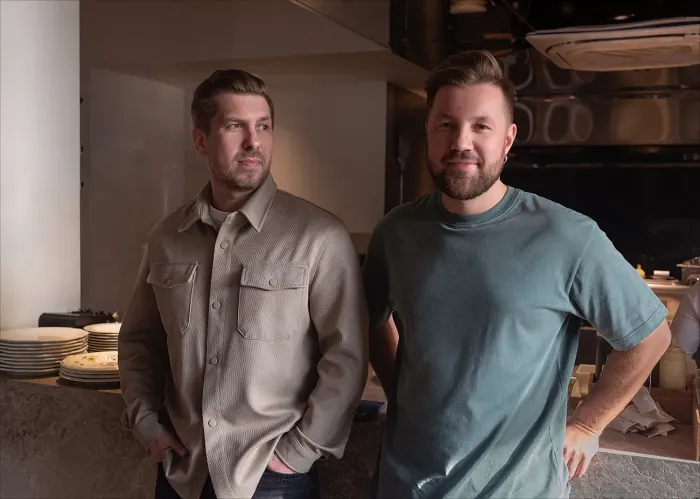
AVA Team Expands Its Horizons: From Patriki to the Middle East.
Vitaly Istomin and Artem Losev on projects in the works, their internship system, and opportunities for regional partners.07.05.25
If you do something and nobody copies it, that's worth thinking about…
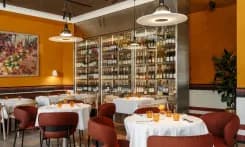
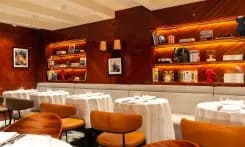
Following the federal restaurant award Wheretoeat-2025, held recently in Kazan, intimate AVA on Patriki — the first project by AVA Team's Anton Pinsky, Vitaly Istomin, and Artem Losev — landed in the top 3 Best Restaurants in Russia. Ahead of the opening of the third AVA Bistro on Nikitskaya and the fourth on Novaya Gollandiya in St. Petersburg, Vkusonomika sat down with Istomin and Losev to talk about new projects, honest pricing, and haters.
In your view too, is AVA the flagship restaurant of AVA Team?
Vitaly Istomin: I don't think so — I think a lot of people confuse the brand and the restaurant. Seriously speaking, LOONA is more deserving, there's a lot going on there gastronomically. And Avrora is our flagship project. But we've got AVA Team, AVA on Patriki, AVA Bistro on Tsvetnoy, AVA Bistro at the "sharik" [the Shukhov-tower dome location]. It's the sum total that gives it the name, I guess (laughs).
Artem Losev: I think for a lot of people it's our most recognizable brand, which gave us our start and the company's name.

Dubai's Loona recently celebrated its first birthday. Has there been enough time to compare the markets?
Artem Losev: There are Russians everywhere — that's our target audience (laughs). I can't say we originally opened with Russians in mind — we didn't even have a Russian-language menu. You open a restaurant and always end up fine-tuning it a bit. We spent a long time hunting for tomatoes, crab, sea urchin. We swapped pork products for beef equivalents. The permits are different too — if you get an alcohol license, you still need to see how it actually works. On the veranda, for instance, you can't sell it.
Vitaly Istomin: Every place has its own quirks, big or small. Fresh juices aren't a thing there, and also everything runs on gas. If we're talking about fundamental differences, though, I think Dubai really loves simple food — the simpler the better — while Moscow and Sochi lean more toward gourmet indulgence.
AL: In Dubai, dinner starts very late. We went recently, for instance: at seven we're sitting there — no full seating yet; by eight we're already asking where the people are, and by nine everyone shows up. They're heading home right around when we're going to sleep. Even when we schedule a chef's table for seven, everyone says — let's push it a bit later. Probably because of the hot days, people need time to rest, get ready, pull themselves together, then go for a walk and to dinner. On the other hand, breakfast is popular there and lunch isn't very. And while in Moscow you need the sun shining on you, in Dubai it's the opposite — you need shade.
Some people go there for the awards, others for the currency — what are you there for?
AL: We went to grow the company across different markets and diversify. We're planning to develop AVA Team in other countries. LOONA, for instance, is already being built in Armenia. We're looking at Uzbekistan, England. We'd also like to get into Singapore, and seriously break into the Middle Eastern market, which is huge — Qatar, Abu Dhabi.
How will you manage working across such a wide geography and different time zones?
VI: Well, there are two of us (laughs). And we have a team — the main thing is to work all the processes out ahead of time. It's important to set up standards and run regular training.
AL: Back when we were small, we trained staff in our own restaurants. While Luna in Dubai was being built, for instance, its chef worked at Luna Moscow, and that's also where all the shift leads training for management positions did their internships. Then we went there ourselves and set everything up. Now we're going to build out a proper training system and write down the standards.
VI: Right now we're focused on expanding the footprint of three projects — LOONA, Narnia, AVA Bistro. And if a really great space comes up, maybe Avrora too. Anton (Pinsky — ed.) went to London to scout locations. We're interested in expansion and capitalizing on the product. Sitting in just one city feels odd. The only real risk is location — we're very confident in the product.
To not get the location wrong in another city, you need to know it well…
AL: We're not just choosing a location — the partner has to be a fit for us too, someone we're ready to invest alongside. So first we go meet them. Investment from both sides is a must. Smaller cities are less clear to us as a market, so we're open to considering franchises if there's someone with a venue who'll put together a team — we train it, and they oversee it day to day. We've sold franchises in Rostov, Izhevsk, Yerevan. AVA Bistro at Sheremetyevo is a franchise. We put a chef and a manager there, either temporarily or permanently, and we try to send our own people, who've been through our school of hard knocks.

What lets you grow at this pace?
AL: Our tireless energy. We used to say this back when we were still working as employees. We get bored just sitting there, and you start degrading, decaying morally
VI: This way we stay sharp. Of course, we're not going to build at the same pace as last year — that was a case of the number of venues and our resources all lining up at once. Right now we've got five projects under construction: AVA Bistro at Depot in Lesnaya, on Nikitskaya, and in Petersburg, LOONA in Yerevan and Rostov. And Istanbul is in the plans. Once everything falls into place, we'll start talking about it — maybe it'll add up to eight projects again. A lot of water passes under the bridge before you shake on a deal.
Does the result always match the plans?
VI: All of our projects change as we go. It's always like that — you open, and a month later it's a different menu. At Patriki, we planned a seafood restaurant, and it turned into a French bistro. Same story at "Avrora": some dishes didn't take off, others unexpectedly flew off the shelves. All four projects got adjusted. Phantom was planned from the start with music and a dance floor, which is why we built it with really expensive sound. But we launched the restaurant first, then breakfast, then the veranda, and only after that, parties. "Athina" ran a season and we wanted to tweak something. We have chef Dima Denisov, who'd wanted to do a tasting set for a while. He first pitched it for LOONA, but that's a different scale of place. We decided to test the idea at "Athina" — now we're selling 30-40 sets a day, 70 on Sunday. We'll launch a second one any day now. Our sets are teamwork, a dialogue. We throw out ideas, the guys run them through their own lens and come back with something of their own — Dima, and Karen Mamyan (chef of restaurant Avrora), and Zhamal (Zholdoshova — AVA Team's pastry chef). There's no strict chain of command on the creative side — we boost things: give an assignment, throw out some references, and the team fleshes it out.
But there was just as much talk about the price of the set as about the set itself. Did you deliberately want to make it super affordable?
VI: I don't get the debate around the pricing. If we're launching a set at a restaurant with an average check of five thousand, the set should cost five thousand. We don't see this as a tool for driving up the check — we see it as a chance to show off the chef's work, to surprise with certain techniques and plating.
AL: Five thousand isn't money? That's very good money. Going for the set as a couple is 10 thousand. "Athina" works for the people — for the guests, not for fat cats. We've covered our costs, gotten the team invested. We're not interested in selling three sets a day and fooling people. What matters to us is that there's demand and the set actually sells. The set is a tool for the chefs' development, for keeping things dynamic, so the company doesn't get complacent. It's a thing ideas flow out of, ideas that can go on to be used elsewhere. And five thousand is a good, honest amount.
Could this approach to sets bring them back into fashion?
VI: Anything's possible. Restaurants are a living organism, everything around us is changing, and we want to change along with it. The industry and guests off the street live in different worlds. If people want a menu with pictures, why shouldn't they get one?
AL: Sure, we've got professional bias and we've seen a lot, but sometimes you have to stop yourself from flying off into space, you have to rein yourself in to hear what people actually want. Fashions change, habits change. Avocado is as commonplace in restaurants now as potatoes, and ten years ago it was hard to find a ripe one. Soon crab-topped sushi will become a Moscow classic. I'm not joking — when something of ours gets copied, we genuinely take it in stride. If people copy you, it means you're doing everything right. If you inspire other people, it means you're on the right track. VI: I'll go further: if you do something and nobody copies it, that's worth thinking about. Sometimes you look at a project and realize there's nothing there you'd want to take — it's just hollow gaudiness.
AL: A lot of our ideas spread far and wide — the roses, the desserts, the sausages, pizzas on different bases, the tableware. Good ideas ought to live on among the masses. If we didn't have Olivier salad now, which someone invented once upon a time, life would be sadder. And a set is always an educational product — people should get to try something new, something interesting.
A line for chef's tables?
AL: There genuinely is demand from people right now for something interactive. At "Avrora," we've already cooked a set at our chef's table several times. It's not really about making money — you can't seat 200 people there, and getting rich off the chef's table isn't the point. We have a restaurant that makes money. This is an experiment, and people go in agreeing it's going to be an experiment. For guests, it's a chance to try and learn something new. For the chefs, it's a chance to build their own set. It's a growth point for a lot of chefs. It's a format you can use to introduce new chefs to journalists. And sell it for reasonable money too.
You're probably among the most active chefs on social media today. Is that work or a lifestyle?
AL: It's the easiest way to reach guests. To show what the restaurant looks like, what's on the menu, that we've got a buggy in Sochi to get you there, that we have parking. It's good for people, coming to a restaurant, to associate it with someone specific. That people aren't just coming to a restaurant, but coming to see Vitaly, Artem, and Anton. A lot of guests write to me — how to book, what to eat, how to sign up for an internship. We have to promote our product by associating ourselves with it. And social media is free.
VI: Of course, on social media you run into more than just reasonable people. Once I asked a hater to justify his position, and he said — you're an upstart, a PR bubble. When you open 10 restaurants a year, you're constantly in the public eye, and some people might not like that. Why should anyone love us? I think in a lot of people's eyes, we're a kind of upstart. But we don't puff ourselves up, we just quietly do our work. We just make our food. The professional community is super biased, and we're not trying to win it over. We're here for the guests.
Do you stand in the kitchen yourselves?
VI: We try to, it's interesting for us too. For instance, at "Avrora's" chef's table we just made a lemon sorbet — not just lemon, but lemon and tahini, an interesting combination; for guests it's an experience, trying something new, an educational process. Or we make pheasant pelmeni — I'm sure not many people do that. Shrimp-and-tuna tartare with a roasted-tomato-and-eggplant sauce — sounds like nothing special, but the flavor combination is really interesting, because tuna is fatty meat, shrimp is fairly lean and slightly sweet, and it's all seasoned with roasted tomatoes, and it all works together really well. You don't have to cook a beaver's tail to make things interesting for people.
AL: We've probably made a thousand dishes over all this time. Even if you assume 90% of it is pop-fare, that other 10% definitely deserves their attention.
07.05.2025
The best places in the city