Whose Restaurant Is SHE in Moscow and What's the Concept
A restaurant with a virtual brand chef and innovative service.20.09.24
Restaurant She in Moscow on Bolshaya Nikitskaya is the first joint project by restaurateur Boris Zarkov and Ksenia Sobchak, who took on the role of brand ambassador for mindful consumption and a healthy lifestyle. Ksenia, known for her unconventional ideas and accustomed to setting the tone in whatever she takes on, managed to spark public interest in her brainchild even before it opened. During the ad campaign, she announced that the new restaurant's brand chef would be an artificial intelligence named Sasha Weiner. Her photo can now be found on the restaurant's official website, and her stories can be seen on an Instagram page.
Even though virtual Sasha's job is to select from recipes proposed to her by real chef Vladimir Mukhin, she's still become the restaurant's signature feature. And the partners aren't planning to stop there: there are plans to introduce a service method where guests' orders, placed via tablets, would go straight to the kitchen. That would do away with the need for waiters and paper menus, and the idea should speed up guest service while simplifying the kitchen's work. For now, though, this idea is still in development.
Ksenia Sobchak's restaurant She has taken up residence in a beautiful corner of Moscow not far from the Tchaikovsky Conservatory. She is a "wellbeing bistro," as its official website puts it — that word can be translated as "благополучие" (wellbeing), meaning it has a proper, healthy menu and an unfailingly positive atmosphere. Among the variety of dishes, there really are vegan starters as well as mains, plenty of vegetable salads, fish, and other seafood, and among the drinks, fresh juices and fruit smoothies.
She's kitchen is a mix of Mediterranean and Japanese culinary culture. As already mentioned, chefs Vladimir Mukhin and Vladimir Baranov handle recipe selection and their signature treatment, while Alexey Kogay runs the RAW bar.

For breakfast, guests are offered porridge, blini, pancakes, farmer's cheese with sour cream, honey, berries, condensed milk, and a few egg dishes. For lunch, you can order soup, a vegetable or seafood salad, pizza, pasta, or choose rolls, sushi, or sashimi at the raw bar. Vegans are offered gluten-free oatmeal with coconut milk, a Buddha bowl with avocado and quinoa, and tomato gazpacho.
Head bartender David Stenshin runs the bar. For guests, he mixes a variety of alcoholic and non-alcoholic drinks, apple and citrus fresh juices, smoothies, coffee, and teas, herbal ones included. Fans of stronger drinks will find vodka, rum, Irish and Scotch whiskies, tequila, vermouths, and cognacs in his collection.
The wine list includes hundreds of labels, mostly wines from France and Italy. In support of feminism, it was decided to set aside a section for bottles supplied by wineries run by women.
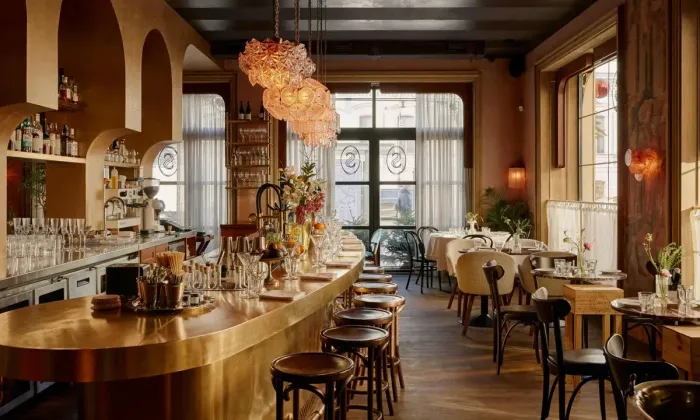
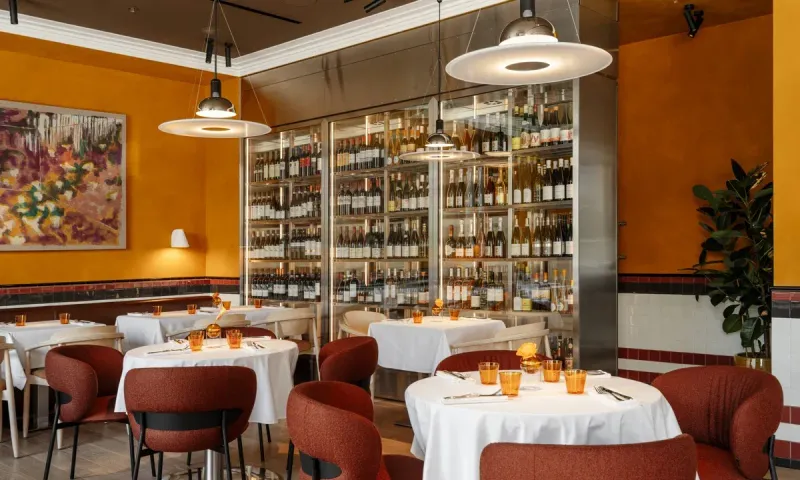
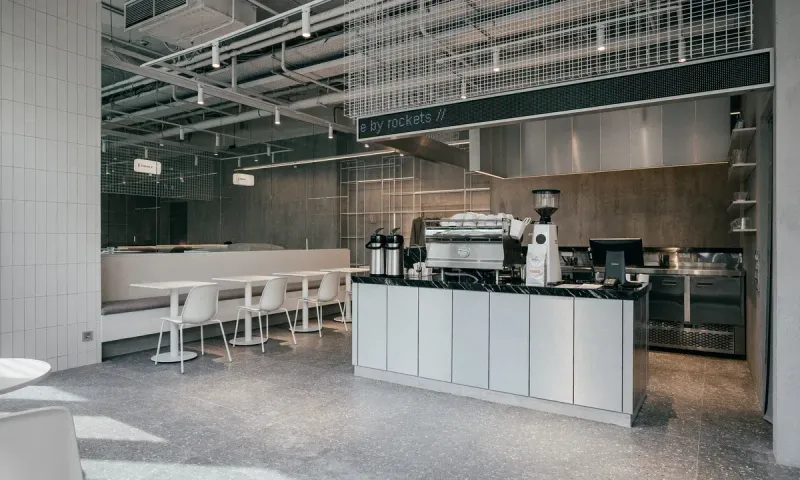
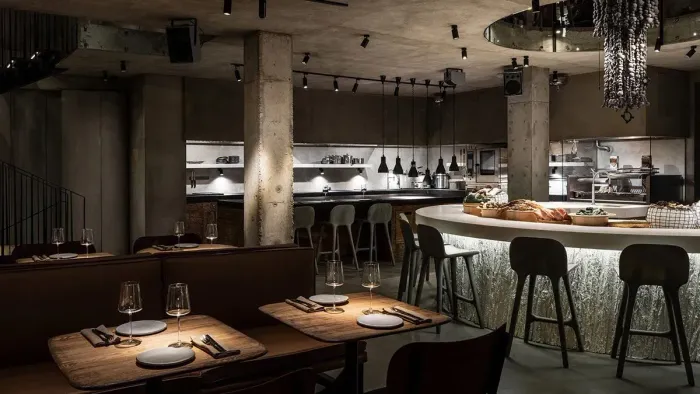
A word on the interior deserves special mention. It was designed by Natalia Belonogova, head of design bureau NB-Studio. The interior is done in a loft style with plenty of concrete and roughly finished wood, yet it came out cozy and chic. The central feature is a five-meter chandelier hanging from the ceiling down to the first floor in the shape of a stalactite, hand-assembled from dark brown and white stones. Part of the walls is taken up by shelving and cabinets holding wine bottles.
The interior is done in a dark color palette, but it doesn't feel oppressive or make the space feel smaller, since dormer windows have been fitted into the ceiling, letting in plenty of light. Sunlight scatters and, as if by magic, fills the whole space, making the lighting natural yet muted.

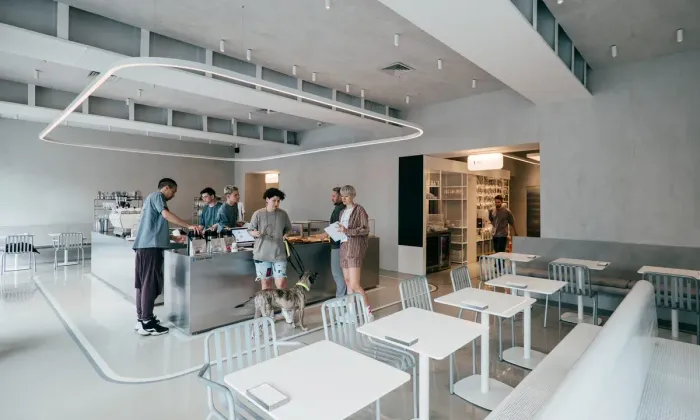
The restaurant's space has two floors. At the center of the first floor sit the cold-prep station and sushi workshop, surrounded by a contact counter and high-top seating. The hot-prep station adjoins it. On the second-level balcony, at the far end, there's a bar with a contact counter and a pizza-making zone. One of the more interesting architectural and design choices was minimizing barriers. Everything is arranged so that the boundaries between floors, guest seating zones, bars, and kitchens are slightly blurred. The absence of sharp barriers makes the space feel light and airy.
After the project's successful launch in 2020, Zarkov and Sobchak decided to build it into a chain and opened a second restaurant on Belaya Square. Its panoramic windows look out on the Church of St. Nicholas the Wonderworker, and unlike the first restaurant, it has a summer veranda seating 85.
There are no fundamental differences between the first and second restaurants. She's interior on Belaya Square keeps to the same loft style with plenty of raw finishing materials, but with more details answering to today's trend — mindful (conscious) consumption. Some plastic furniture elements, as well as parts of the waitstaff's uniforms, are made from recycled material, and the wooden chairs are assembled from the legs of old, broken chairs.
The menu, too, is kept unchanged. The exception is the pizza-making method: on Nikitskaya it's baked over open fire, while on Belaya Square it's baked in an electric oven. But the dough-making method stayed the same: it's made from five kinds of flour on a special wheat starter.
Both She restaurants in Moscow are fashionable, modern culinary hubs of the capital, fully living up to the stated trend toward mindful, conscious consumption and a healthy lifestyle.
20.09.2024
The best places in the city