Chef Vladimir Mukhin — a Culinary Legend of Modern Russian Cuisine
Russian chef, winner and medalist of international culinary competitions.19.08.24
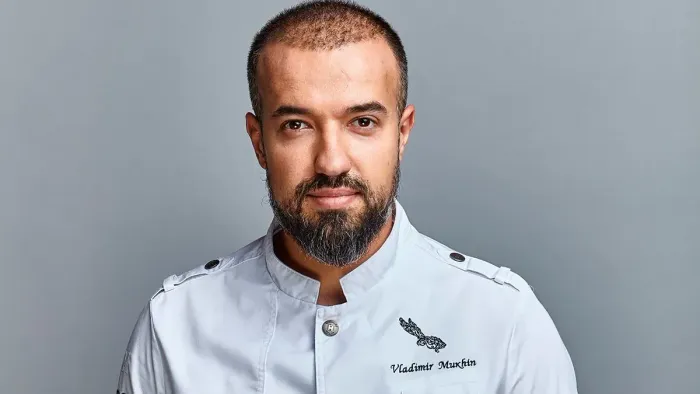
Vladimir Mukhin can, without exaggeration, be called a culinary legend of modern Russian cuisine. He's won various competitions more than once, worked at a great many restaurants, and opened quite a few of his own. Today he doesn't just cook — he collects forgotten recipes from across Russia, speaks at various events, and does everything he can to develop traditional cuisine.
Vladimir's profession was determined at birth. He was born on March 15, 1983. His family had kept up the cooking profession for several generations, so Volodya himself was destined to carry on the tradition. By the chef's own recollection, it was his grandmother, Fedosya Kireevna, who held a leadership position at a catering-industry association, who invested the most in his culinary upbringing. His grandfather, a master of vocational training, showed him how to properly store and prepare ingredients. His father, together with a friend who also happened to be the mayor of Samara, opened restaurant "Samarskaya Pristan" in Essentuki, and also had his own patisserie.
It was at his father's restaurant that fifth-generation cook Vova Mukhin began his professional path. His very first job was entrusted to him at age 12 — he washed pots in the kitchen. Then he was given more complex tasks, like butchering beef carcasses, as well as keeping a close eye out for staff theft. The harsh nineties dictated their own terms... No matter how hard his father tried to draw his son into the family business, Vova decided to leave and go conquer Moscow. There he enrolled at the Plekhanov Russian University of Economics, in the department of food service technology.
While in his first year studying to become a food-service process engineer, the young man had the good fortune to meet Alexander Filin, president of the "Otkrytaya Kukhnya" ("Open Kitchen") chefs' guild. They agreed on an internship, after which the young man got a position at restaurant "Krasnaya Ploshchad." That fateful meeting can be considered the starting point for the star chef's career.
After graduating, the cook continued working with Filin. Restaurant "Buloshnaya" opened next, where Volodya Mukhin took the chef position at 21. He went on to study the culinary craft at other restaurants, among them "Belgrad," "Kitay-Gorod," "Nostalgie," "Pushkin," and Scandinavia. He also trained at Philippe Park's French Academy of Gastronomic Art.
Even at the very start of his career, Vova devoted a lot of attention to pre-revolutionary culinary traditions; he was inspired by the idea of making Russian cuisine majestic, wanting to elevate it in the eyes of connoisseurs worldwide and make sure people talked about it everywhere.

In support of his idea, Mukhin set out to conquer France with his Russian recipes. At the invitation of the city administration of Avignon, for two years running (2008, 2009), together with French chef Christian Étienne, the Russian chef and Park Academy trainee held Russian cuisine weeks and the "Russian Christmas" gala dinner at restaurants in Provence: "La Vieille Fontaine" at the Hôtel d'Europe in Avignon and "Christian Étienne," both recognized by the Michelin guide in Avignon. Vladimir's contributions were recognized with thanks from the city's mayor.
In 2010, the Russian evenings ran again in Avignon, as well as in the village of Barroux, at the restaurant of the same name. Europeans took a liking to Russian cuisine, and Mukhin headed home to keep studying old, pre-revolutionary recipes in libraries, expeditions, and monasteries.
During his time at "Buloshnaya" he met Boris Zarkov. In 2012, Boris owned restaurant White Rabbit and ran the restaurant alliance of the same name. Zarkov tried dishes cooked by Mukhin several times and finally decided to invite him to the chef position at his restaurant. It had just opened up after Konstantin Ivlev left, prioritizing his television career instead. From there, his professional growth continued within WRF.
The WRF alliance began with a single restaurant, opened in 2011, inspired by Lewis Carroll's tales. In 2012, once the flagship restaurant's kitchen landed in young Mukhin's hands, the family started growing actively. The chef was directly involved in practically every project. Today the "rabbit family" numbers more than 30 restaurants, many of which the chef has a direct hand in. .
In 2014, Red Fox opened in Sochi, at the "Rosa Khutor" resort, ahead of the Olympic Games. Then, in 2017, Mukhin became a co-founder of the international culinary festival IKRA, and later the 18-seat gastro-theater Chef's Table by White Rabbit opened. Even so, the chef doesn't set Chef's Table apart as a separate restaurant, but treats it as a space within "the Rabbit" where he can express his culinary imagination and share it with guests.

In 2018, Mukhin opened restaurant "Gorynych" as brand chef. That same year saw the grand launch of fish restaurant "Sakhalin," with a panoramic view on the roof of the "Azimut" hotel. There, chef Mukhin built a concept around regional ingredients, used to create dishes from Mediterranean and Asian culinary traditions. Two more projects with Mukhin's involvement launched in 2020: the immersive gastro-project Krasota and wellbeing bistro SHE, a joint project with Ksenia Sobchak and Sasha Weiner.
White Rabbit Lab is a unique project of the holding, a space for creativity and culinary experimentation. It brings together cutting-edge technology that allows for running culinary experiments and then sharing them with guests. From time to time, the lab presents tasting sets that are developed and served right there.
At a time when all of Moscow, and the country as a whole, had shut down for quarantine, Mukhin and his team had no intention of saying goodbye to the restaurant business. So they decided to take it to a new level. That's how online dinners came about. The team prepared the ingredients, packed them into individual labeled boxes, and a courier delivered these "kits" to guests' homes. At a set time, all participants joined an online session and, under the chef's guidance, assembled and finished the dishes, plated them beautifully, and got to enjoy a refined dinner, just like at a restaurant, in pleasant company.
In total, over the course of the lockdown, Mukhin ran more than a hundred dinners. Our Russian chef wasn't the only one who took part in this project. Cooking alongside him were chefs Virgilio Martínez, Jorge Vallejo, Zaiyu Hasegawa, Dominique Crenn, Bo Songvisava, and others. Money from these dinners went entirely toward supporting kitchen and floor staff at the restaurants. Mukhin's team, together with the Electrolux brand, also cooked and delivered about 60 meals daily to medical workers in COVID zones.
2013 — "Best Young Chef in Russia," runner-up at the international San Pellegrino young chefs' competition.
In 2014, thanks to Mukhin, White Rabbit took 71st place on The World's 50 Best Restaurants.
In 2015, White Rabbit — 23rd place on the world's 50 best restaurants ranking.
In 2016 — 18th place.
In 2017 — 23rd place in the top 50, 4 toques from French guide Gault&Millau, the title of "legendary chef." That same year, Netflix's Chef's Table featured Vladimir Mukhin. He was noticed after the San Pellegrino regatta and invited to appear in a season 3 episode.
In 2018 — 15th place in the best-of ranking.
In 2019 — 13th position, ninth on the list of the world's best chefs according to the professional Best Chef Award, and the "Best in the Industry. Chef of the Year" award from the professional community "Palm Branch of the Restaurant Business"
2020 — Chef of the Year according to the national restaurant award WhereToEat Russia, 25th place on The World's 50 Best Restaurants 2020 list.
2021 — 9th place in the ranking of the world's 100 best chefs, White Rabbit — 25th place on the list of the world's best establishments. A Michelin star and a spot in the guide for 2022 for "White Rabbit."
Vladimir is a chef who carries the banner of Russian cuisine. Not the familiar Soviet past that many know, but a forgotten culinary art built on genuinely Russian ingredients, unjustly forgotten and pushed out by foreign ones. He strives to popularize Russian cuisine around the world, make it recognizable, give it its own "voice," and turn it into a trend.
His tasting sets "Domostroy," Russian Evolution, "Contrast," and the prophetic "Black Swan," which appeared right before the pandemic, were built around a zero-waste concept and also supported the trends of food-as-medicine, glocalization, digital seasonings, and the music of vegetables and fruit. In 2020, "White Rabbit" reopened with a new interior, and to mark the occasion the chef presented the set "Metamorphoses." It also became a retrospective assessment of his culinary path. And today, Vladimir actively cooks in the evenings in "White Rabbit's" kitchen, while during the day he handles ongoing matters across the alliance's restaurants.
19.08.2024
The best places in the city