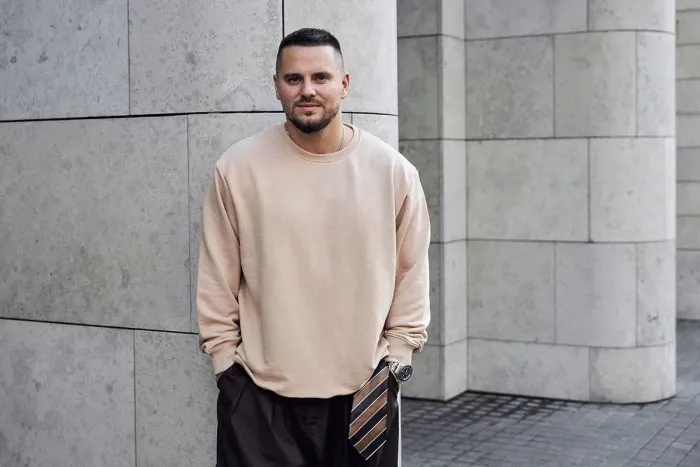
Chef and Restaurateur Alexey Alekseev
St. Petersburg chefs are hungrier, so they need a bit more13.08.24
Chef and restaurateur Alexey Alekseev on his new 400-hectare project in the Pushkin Hills, on why an A in math beats an A in Russian, and on what breaking your spine can teach you
— Not everyone's gotten used to the fact that you're not just a chef now but a restaurateur too, and you've already announced you're building the Alexander Residenze tourist cluster in the Pskov region. Who do you feel more like right now?
Right now I'm sitting here paying bills and salaries (laughing, shows his mobile banking app). Who am I? Right now, probably an entrepreneur, a restaurateur. When we open restaurant "Itameshi" very soon, I'll be a concept chef and a restaurateur. I guess I'm not just one thing right now. But I really love feeling like whoever I am at the moment. I'm probably a disappointment to some people, because I'm not standing over the stove 13 hours a day anymore, the way a lot of people would like. But I like opening projects. I like running a business, I like being a concept chef.
— And how do you feel about that yourself? Do you regret not having enough time for it, or the opposite — do you feel relief?
Sometimes you just want to stand in the kitchen and not deal with anything else, not tax your brain. You stand in the kitchen, create something beautiful, deliver delicious food. Everyone's happy or not. And that's where your job ends. But here you often carry a completely different kind of responsibility. You sleep less because your head is always working. Sometimes it wears you out, sure. Sometimes you want to stand in the kitchen and remember how great it was to just get a paycheck once a month and generally be happy. But I wanted to be more independent, more free.
— Does your group already have a name?
Good question, actually. We've got a couple of ideas, but we haven't made a final choice yet. So we decided to run a contest — whoever comes up with the best name gets invited to dinner at restaurant Itameshi.

— As far as I know, you don't have a business education, or even a vocational one? How are you handling these new tasks and responsibilities?
I really did become a cook by accident, but it was fate. After ninth grade I enrolled to become an auto mechanic, because I had to enroll somewhere. And one day, at a get-together, I saw a guy who took it upon himself to cook dinner for everyone. And he did it so masterfully that I watched, mesmerized — it all seemed like magic to me. Then he got me a job in the kitchen, and I felt this was mine. I was fanatical about the craft, studied everything I could find, bought up books, spent all my money on internships, constantly traveled abroad to learn. I take the same approach to what I do now.
— But how do you level yourself up?
Hard to say. I don't go to business conferences, don't listen to speakers — maybe that's my mistake, but it all just happens situationally somehow. For instance, when we were opening Futurist, a lot of it was new, I didn't know anything at all about business. I had to go through all of it myself. You learn not from theory but from practice. You go to someone you consider an expert in the area you need, sit down with them, and say — explain this to me. Good thing I'm solid at math. I always got A's, I'm fine with numbers. Even as a kid, my grandfather and I used to add up the numbers on car license plates on the way to school. I might be a bit slower now, but I can still add up a dozen cars like that with no trouble and give a clear answer. By the time people reach for a calculator, I've already done the math. Unfortunately, it's not like that with Russian. Now, after opening Futurist, we've been through the whole operational side, and it's a lot easier for me now, because I know what labor cost is, food cost, ABC analysis, cost price. I basically knew that plus or minus already, but now that it's all passed through me firsthand, I understand how a business actually moves.
— What role model were you drawing on, whose example did you have in front of you thinking "that's how it'll be for me"?
The example in front of me, of course, was my friend Dmitry Blinov.
— Wait, hold on, he's pretty young for an example, you're the same age, aren't you?
No, he's 5 years older than me. Blinov's 39, I'm 34. You think he was 33 just yesterday? He's an old hand by now! (laughs) When I went on my first internship, his restaurant was already, I think, two years old. There wasn't anyone like that on the Moscow market. There was grown-up, you know, hardcore Novikov. But those were a different caliber of people to me.
— By the way, why the different caliber? Why did St. Petersburg chefs start turning into restaurateurs so early, while in Moscow the average restaurateur is some solid, grown-up figure?
Honestly, I don't understand how it happens. Well, if I picture a Moscow restaurateur in my head, it's definitely someone who was never a chef. Just a hotshot businessman, authoritative, maybe with connections in power. Whereas St. Petersburg restaurateurs are often ordinary guys. How they pull it off, I don't know. Maybe they're a bit hungrier? If you're from a super well-off family and everything's fine for you, you definitely don't go work in a kitchen. You're probably studying law.

— And without any education, they just do it on pure enthusiasm, boldness…
On energy. You can learn anything. Well, you can also, sure, screw up to the tune of 50-100 million.
— Listen, but you're moving at such an incredible pace. Why did you take on this pace and why aren't you afraid?
It's like we only get one shot on this planet. What's there to be afraid of? If you have a goal, a dream, a vision — you just have to take it and do it. If I had nothing to do with the restaurant business, I probably wouldn't have taken any pace at all. People come to me from time to time saying, let's build a restaurant. I calmly say I'm not sure. If you don't have the competence in this field, especially in St. Petersburg, you shouldn't get into it. It's a very tough business.
— What questions do you ask these people to figure out whether it's worth getting involved with them at all, whether it's worth doing business with them?
The main thing is whether they're ready to fully step back from the business and trust it, 100%. Because if you give a certain amount of freedom on that front, chaos can break out. Some co-founder's wife will show up and start giving advice. It's all a waste of time. If you've come to a professional, you have to trust them completely and go in that direction with them.
— And what do you dream about, for yourself, overall?
I want to become an investor. I'd like to be able to help other guys like me who can actually do things. And naturally, to have a certain financial independence of my own by then too.
— Okay, what comes after the park hotel? It's already clear the park hotel will be interesting.
A hundred percent. I've fallen so much in love with the project, I'm so immersed in it, it's just something really great. I love the Pskov region a lot, I spent all my time there as a kid. When I come there, I step out of the car, I smell that smell — it's just something incredible.
— Okay, what then? It's hard to imagine a bigger business after the hotel — what should we expect, different geography, a chain, a franchise?
Well, look, we're also considering a spot on Lake Turgoyak right now. The Karelian direction interests me enormously, from the hotel angle. Restaurants — yes, Moscow, of course. I want to open in Moscow. There's a lot I want.
— You're genuinely hungry, somehow.
Yeah, very much so. Maybe that's why I broke my back in May. My mentor, a Chinese man, told me — you got twisted up energetically. I needed to stop. Because there's so much responsibility, so many projects, so many people I'm now responsible for. And I was lying in the hospital thinking, if something's really wrong, maybe I won't even walk again. It's a bit funny now. I had two options. Either I send my family to Turkey for a week and work, or we fly together. I said, go without me, I'll put in some solid work here. And that's what happened. I thought, what an idiot I am. What could be more valuable than time spent with family? Nothing in this world. Because everything can end at any moment.
— But surely there's something you look back on with a smile too?
Sure — the most recent one is a one-man picket outside Futurist's window. When we took the Kamchatka crab pie off the menu, one of our guests printed out a huge poster, stood outside the entrance on a Friday with this banner, and shouted "bring back the crab pie!" Honestly, I was in shock. That guest and I keep in touch now, we know each other, but unfortunately, the pie never came back.
13.08.2024
The best places in the city