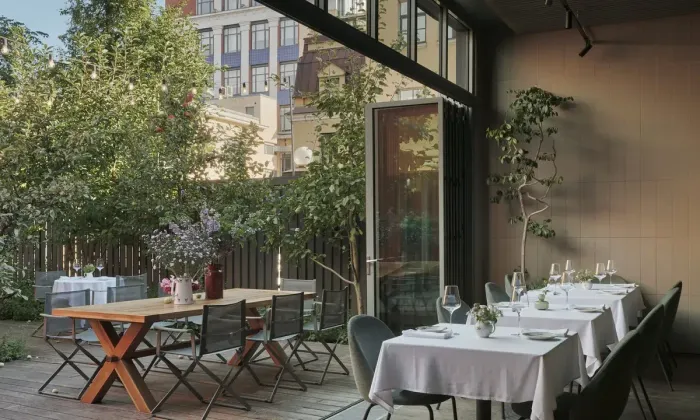
The Best Restaurants with Terraces in St. Petersburg
18 St. Petersburg restaurants with verandas, terraces, courtyards, and gardens — for summer breakfasts, lunches by the water, and long dinners outdoors.24.07.26
Maybe there's nothing better than a good table in good company. Except, perhaps, that same table — on a veranda.
The best restaurants with terraces in St. Petersburg aren't just a summer option — they're their own genre of city life. Here, a veranda can look straight out onto the Neva, hide in a quiet Petrogradskaya courtyard, open onto New Holland park, or hang over a canal two steps from St. Isaac's. St. Petersburg was made for eating outside: the white nights turn any summer dinner into an event, and the right spot with a view of the water or a historic façade makes it unforgettable. We've put together 19 addresses — from Italian bars with Spanish jospers to restaurants that feel like a ship's deck — where summer is especially good. With food, wine, and open sky.
Petrovsky Prospekt, 9L
'Lodochnaya Stantsiya' ('Boat Station') stands on Petrovskaya Kosa, right at the edge of the Malaya Nevka, and the veranda here isn't a decorative touch — it's the whole point. The view of the water and the bridges opens up from the terrace unobstructed: no embankment, no fences, no parked cars between the table and the river. The kitchen runs on Mediterranean logic — fish, seafood, pasta, dishes cooked over fire and coals — and pairs well with a glass of wine outdoors. A place for anyone who wants more than lunch by the water — who wants to feel that St. Petersburg knows how to be a summer city.
Admiralteysky Canal Embankment, 2M
Kuznya House lives inside New Holland, and in summer that's already half the answer to "why here." The terrace becomes part of the island: the park, the air, the people, the evening life are all right there. Chef Ruslan Zakirov cooks comfortable European food without strict geographic boundaries — chicken pâté with apricot, tartare, lamb with new potatoes, lasagna with truffle and four cheeses. Salmon, pastrami, and ham are made in the restaurant's own smokehouse, and bread and croissants are baked daily. After midnight on weekends, the restaurant slides easily into club mode.
Giallo is put together like a frame from 1960s and '70s Italian cinema: mahogany, vintage armchairs, a curved bar counter, Murano glass, and a vinyl record collection in one of the rooms. The kitchen here is Italian but without academic strictness — more comfort food, which works best alongside the signature cocktails. The bar is the main argument for the evening: drinks are made precisely and with mood. The terrace continues the same visual language, just with more air. A good plan: aperitivo outside, then dinner and one more cocktail inside.
Sight Coffee & Dine grew out of Moscow's Nude and kept its tightness: bright minimalism, a brick wall, careful plating without unnecessary flourish. Until two in the afternoon, it's coffee, breakfast, and pastry — a blueberry-and-yuzu bun, an oat scone with jam, pistachio and poppy-seed items, shakshuka with roasted vegetables and focaccia. In the evening, the focus shifts to wine and light food. The terrace shows the morning scenario at its best: sit outside with a coffee before the city has picked up speed, and take your time starting the day.
Da Manu is Probka Family's intimate pizzeria, with a 26-seat room and one of the most pleasant summer setups in this part of the center. Inside: marble tables, Karelian birch, a crystal chandelier, and a reproduction of a Luca Giordano painting. Brand chef Manuel Suraci handles the pizza on its ultra-thin, crisp crust: from margherita to mortadella with pistachios. Chef Aleksandr Sabitov runs the hot dishes and starters — vitello tonnato, tartare, pasta with crab, tortelli with burrata and truffle. A small format, but built with a lot of care.
In summer, Atele on Lakhtinskaya really does feel like a little Barcelona on the Petrogradskaya side: a bright terrace, the "No Bad Days" neon sign, a copper chandelier, and a lively street rhythm. Chef Vladimir Vorgulev builds the menu around a josper fired with grapevine wood, giving meat, fish, and vegetables a clean smoky edge. The menu includes Iberico jamón, Basque pintxos on house-made brioche, octopus with mashed potato, machete bread with smoked sweet potato, and churros. Behind the bar: orujo, pacharán, Galician cider, and contemporary gins. A place for an aperitivo that easily turns into dinner.
Vegetables stopped being a side dish here a long time ago — Dmitry Blinov and Renat Malikov built an entire philosophy around them. The menu sections at Harvest are named exactly that directly: "Vegetables Only" and "Not Only Vegetables." The summer terrace continues that idea naturally: the open air and the light natural materials of the interior work in the same register. Try the beet, dried in powdered sugar, with young cheese — one of those rare cases where simple execution turns out sharper than complex technique. Instead of wine: fresh-pressed juices from vegetables, fruit, and berries — not the obvious choice, but a convincing one.
Behind the façade of restaurant 'Sad' ('Garden') an apple orchard is literally growing — the founders planted it themselves, and it doubles as the summer terrace. Chef Anna Ryaznanskaya builds the menu on ingredients familiar since childhood but plates them so the flavor stays clean, without unnecessary layering. Inside: porcelain with a botanical pattern, white tablecloths, and a fireplace; in warm weather, all of it gives way to live branches and open sky. Head sommelier Adelaida Iskhakova put together a list from the classic premium regions. A place for anyone looking not for a trendy address but for a lunch with character and food that makes sense.
Juan Espanola Cantina is tucked into the courtyard of the Myasnikov mansion, and that hidden location only makes the effect stronger. Inside: stained glass, tiled surfaces, archways, and tropical plants; in summer, the courtyard turns into a terrace with lounge chairs and a ping-pong table. The kitchen runs on a Josper oven fired with wood and grapevine: the machete bread with smoked sweet potato comes out with exactly the right smoky finish. Alongside it: tapas, paella, jamón, and tacos on corn tortillas. The bar is heavy on tequila and mezcal, with margaritas and fresh-juice cocktails — the evening tends to get longer than planned.
Frantsuza Bistrot from Duoband: bentwood Vienna chairs, marble, mirrors with patina, and brown lampshades — French mood without the kitsch. Chef Ivan Frolukhin doesn't lock the menu into the classics — fennel and asparagus crudo with goat cheese and scallops Grenoble-style sit next to brie with truffle and more familiar bistro standards. The table is set with faience from the rare French brand Gien, a rarity in St. Petersburg. The summer veranda continues the same rhythm: a relaxed lunch, a glass of French wine, unhurried conversation. The list has 15 wines by the glass, plus a wine of the day worth asking about separately.
Inner took two years to build, and it shows in the attention to detail. The three rooms are each arranged differently: one with panoramic windows and botanical manuscripts on the ceiling, another with an almost monastic austerity, a third resembling a refectory. Designer Evgenia Uzhegova worked with frosted glass, wood, and paintings by a St. Petersburg artist. The open kitchen is positioned like an altar, and chef Aleksey Alekseev matches that scale: tomato ceviche with kimchi, chicken broth with bacon wontons, Jerusalem artichoke gratin with baked milk. The veranda makes the experience less solemn.
Inner Bakery opens at eight in the morning, and by then the bread is already ready. Chef Aleksey Alekseev drew inspiration from Copenhagen bakeries: the Danish pastry here is all signature work — pears simmered in wine, cruffins built from blends of dried berries, croissants filled with blackcurrant pastry cream. The space, with high ceilings, old wooden beams, and a large communal table by the panoramic windows, was designed by Evgenia Uzhegova. In summer, an outdoor area is added — the right place to start a St. Petersburg morning with coffee and fresh rye or buckwheat bread with onion.
Futurist is chef Aleksey Alekseev's first restaurant project, where attention to detail extends to the porcelain: the plates echo the railings of the Mikhailovsky Garden and Quarenghi's paintings from the Hermitage. The space, with its cubic ceiling structures and panoramic glazing, looks almost architectural. That line continues on the veranda: the city's history stays in the background, but dinner feels lighter. The menu includes Northern shrimp with calamansi and passion fruit, tartare with pike caviar, and French toast with shrimp and parmesan mousse. The experimentation here is for precision of flavor, not for effect.
Aster on the Nikolskaya side is a café-bakery people visit in the morning and often stay at until lunch. The main draw is the display case of croissants and buns; the bread and pastry stations work behind the glass. Maria Kachalova's two bright rooms are put together with a calm hand: wood, sofas along the walls, milk-colored boucle armchairs. A spacious terrace hides in the inner courtyard — a rare quiet St. Petersburg courtyard, free of street noise. The menu includes scrambled eggs with truffle and smoked suluguni, avocado toast, sandwiches, and pastries. Another plus: it's dog-friendly.
AGA on the Petrogradskaya side spans more than a thousand square meters and doesn't hide its scale: an open kitchen with a wood-fired oven, an ice display for seafood, marble, leather armchairs, a glass chandelier. In summer, the spacious terrace becomes a scenario all its own. Brand chef Almaz Iskakov and chef Pavel Sukhoparov hold a course toward Italian and Mediterranean cuisine: Cantabrian anchovies with mozzarella, fritto misto, sea bass in acqua pazza, steaks, and pasta. The seafood is imported by the restaurant itself, and it shows. The restaurant is at its best with a large group.
Closer's windows look out onto Tavrichesky Garden, which sets the tone for the evening right away. APAA Studio put together a calm, almost gallery-like room without any showiness. The kitchen's center of gravity is open fire: an Italian wood oven and a Spanish charcoal oven run through most of the dishes. Brand chef and co-founder Maria Dementyeva builds the menu not by geography but by the logic of heat and smoke — ingredients come out deeper, denser. Angelina Gayvoronskaya's wine list reads like a library of rare bottles. A separate lounge with furniture by Carlo Scarpa and Mario Bellini works like an intimate world within the restaurant.
The trip out to 'Ryba na Dache' ('Fish at the Dacha') is already part of the pleasure: a wooden Honka house standing in Sestroretsk, on the bank of the Sestra River, amid nearly six hectares of northern nature. Probka Family built a restaurant here that changes with the seasons. In summer, hammocks hang beneath the trees, chef Oleg Babaytsev spit-roasts lamb on weekends, and the terrace hosts large groups. In winter, a different scenario kicks in: a fireplace, a library, an ice slide in the yard. The kitchen relies on house-smoked fish and dacha classics: borscht, pilaf, lyulya kebab, and a "fisherman's pot" for the table.
The building on Bolshaya Konyushennaya remembers the 19th century and Russia's first cocktail bar, 'Medved' ('The Bear'). Today it houses Goose Goose, a two-story Italian restaurant where the address's history doesn't weigh the place down — it sets the tone. There are two outdoor spaces: a quiet terrace in an enclosed courtyard and a street-side spot facing the center's façades. The Italian cooking is put together without heaviness, and the bar menu echoes the address's cocktail past. There's a separate lounge with a balcony for private events. Tourist foot traffic barely reaches here — a rare advantage for such a central address.
24.07.2026
The best places in the city