Chef’s Table by WRF
Smolenskaya Square, 3
Opens at 13:00


Opening hours:
Opens at 13:00
Monday13:00-00:00
Tuesday13:00-00:00
Wednesday13:00-00:00
Thursday13:00-00:00
Friday13:00-00:00
Saturday13:00-00:00
Sunday13:00-00:00
Smolenskaya Square, 3
Opens at 13:00
Opening hours:
Opens at 13:00
Monday13:00-00:00
Tuesday13:00-00:00
Wednesday13:00-00:00
Thursday13:00-00:00
Friday13:00-00:00
Saturday13:00-00:00
Sunday13:00-00:00
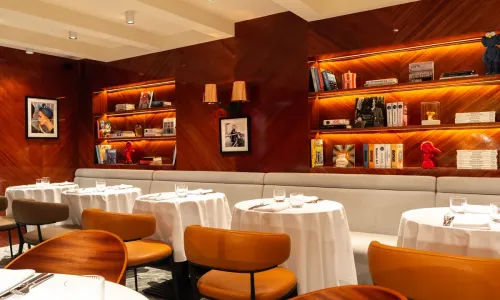
Chef's Table by WRF at Smolenskaya Square, 3, is an intimate tasting-format restaurant-theater, where Vladimir Mukhin and his team present gastronomy as a live performance.
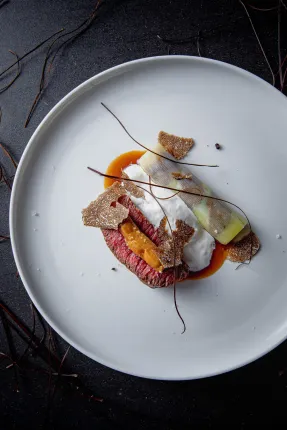
Chef's Table by WRF at Smolenskaya Square seats only twenty guests. It's the first interactive restaurant-theater format in Russia, where dinner is built around a tasting set and the team's work at the open kitchen. Guests watch the dishes come together, hear the cooks' commentary, and follow the plating logic from course to course.
Our restaurant guide's team finds this one of the best chef's tables in the country, and certainly one of the best in the world. Both the balance of flavor and texture, and the story behind each dish, matter here.
The project is tied to the name of Vladimir Mukhin, and master chef Vladislav Alekseev runs the kitchen in the room. The standing repertoire includes the sets "Awakening," "Signature Season," "Vladivostok" and "Back to the Future." These menus are built around seasonal themes, regional stories, and a contemporary view of Russian gastronomy.
Gleb Shelomanov runs his own tasting line: "Boiling Point," "Taste of Spring" and "Our Fairy Tales." As a result, several original approaches exist within one space, and the place isn't reduced to a single evening's script. The guest doesn't just choose a dinner but a specific culinary program.
The "Heirs" format brings together WRF's young chefs, who cook a new menu each time with no repeats. This is where the restaurant shows itself most strongly as a platform for experimentation, where what matters isn't an archive of hits but the specific evening and the specific team.
Intimacy remains a key part of the experience. The small seating capacity lets guests ask questions as dinner unfolds, watch the kitchen's work up close, and experience the plating not as a service ritual but as part of the production. Here, "restaurant-theater" isn't a figure of speech but a precise description of the format.