Tyurki Diner
Nebesny Boulevard 1k1, ALIA residential complex
Nebesny Boulevard 1k1, ALIA residential complex
Folk Team's first project outside the center — a mix of diner and Turkic cuisine. Tandoor, kazan, a 20-layer phyllo baklava, and cocktails with saffron and rose.
When a restaurant group with five successful projects in central Moscow suddenly opens a sixth near Spartak metro station, that raises questions. But it only takes an evening at "Tyurki Diner" to understand the logic: the neighborhood is growing, and Folk Team wants to grow with it. In spirit, the place recalls a mid-20th-century American diner, except instead of burgers and milkshakes, there are tandoor kebabs and a rose-petal sour.
Our restaurant guide's team finds Folk Team's move beyond the Third Ring Road an ambitious, unconventional step. Everything suggests the format could grow into a chain.
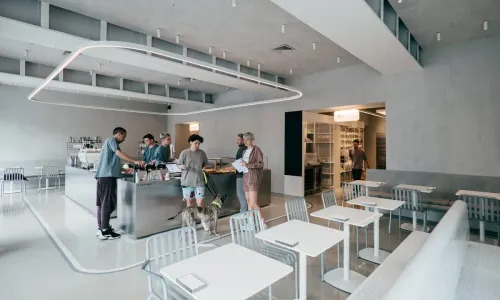
In the morning, the place smells of freshly ground specialty coffee and warm pastries — a coffee zone with sweets and Turkish tea operates here. By evening, the room reshapes itself: the open kitchen fires up, the bartender starts mixing signature cocktails, and "Tyurki" turns into a full restaurant with an Eastern character. On weekends, families come here — a kids' zone and workshops for the younger guests continue a tradition Folk Team established back in its first project.
Behind the open-kitchen counter are a tandoor, a mangal grill and a kazan cauldron. Fire sets the tone for the whole menu: chicken slowly cooks through in the clay oven, lamb shashlik is grilled Uzbek-style on short skewers, and the rice for plov simmers down to its characteristic smoky flavor. Nearby, manti are shaped and dough is rolled out for samsa. Among the soups, try the rich bozbash — lamb, prune and apple give it an unexpectedly delicate flavor. All the sauces and meze are fermented right on site.
A particular point of pride is the pastry workshop. Classic Turkish baklava is assembled from twenty layers of hand-stretched dough: part of the work is done on a machine brought from Istanbul, but the final stretching is done by hand. A Baku version with walnut and cashew, a saffron tres leches, a thyme medovik, and a halva-and-cornel-cherry mousse — all made in-house, with no semi-finished products. The bar list is built on reinterpreting familiar formats: the gimlet here is made with Uzbek lemons, and the espresso martini uses strong Turkish tea with pomegranate syrup instead of the classic coffee liqueur.
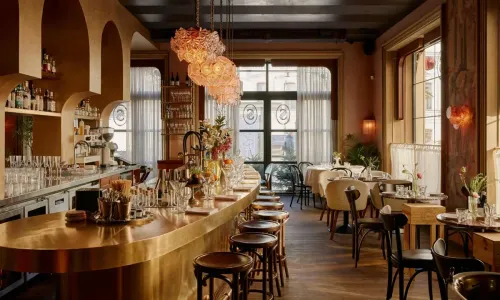
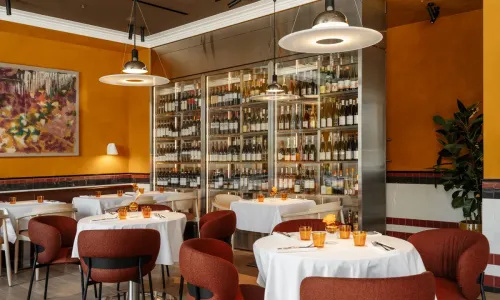
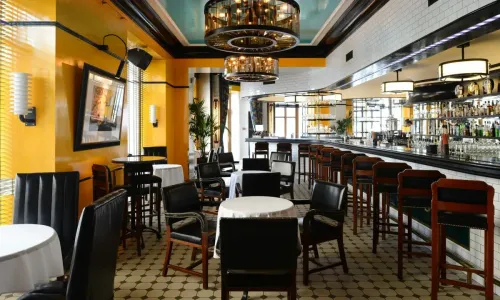
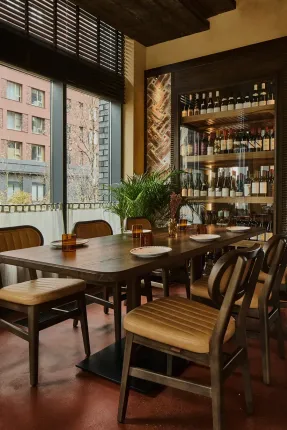
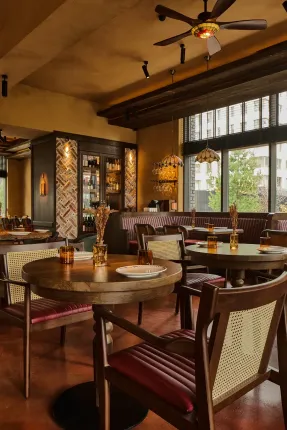
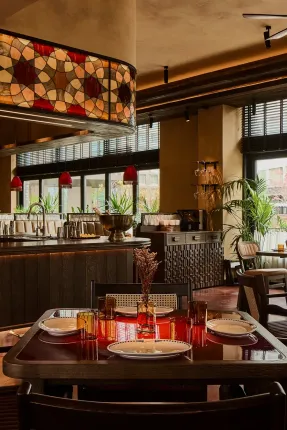
The space is styled as a journey between two worlds. On one side: leather booths and the diner's chrome accents. On the other: walls the color of ripe apricot, patterned floor tile, custom star-motif stained glass, and light fixtures evoking the Tiffany era. The main art pieces: a multicolored stained-glass light box at the border of the kitchen and the bar, and a wine cabinet inspired by the carved Eastern mashrabiya balconies.