18 Best Sushi Bars and Japanese Restaurants in Moscow
The Taste editors' ranking of the 18 best sushi bars in Moscow — from premium omakase to affordable sushi bistros.05.04.25
Japanese cuisine in Moscow has moved well beyond Philadelphia rolls. Today the city has dozens of serious sushi bars — from intimate ten-seat omakase spots to multi-room projects with an izakaya format and pan-Asian menus. We've gathered the 18 best sushi bars in Moscow, the ones setting the standard for Japanese cuisine in the capital. The roundup features restaurants with their own fish supply chains, signature sets, and chefs who've trained in Tokyo.
B. Nikitskaya, 24/1s6
An intimate Japanese project built around the philosophy of omakase — a format where the guest leaves the dish selection entirely to the chef. Behind the counter is chef Alexey Lopatin, who honed his technique at Tokyo's Nobu under Nobuyuki Matsuhisa and at New York's Sushi Nakazawa under Daisuke Nakazawa. That experience defines everything — from the rhythm of service to the choice of fish.
The menu is built around a limited set of items: sushi, sashimi, nigiri made from seasonal fish and premium-class seafood. Every set is signature, and there's almost never any repetition between visits. Mikhail Polkin curates the sake collection, and the cocktail list was put together around a color concept — every drink has its own chromatic idea.
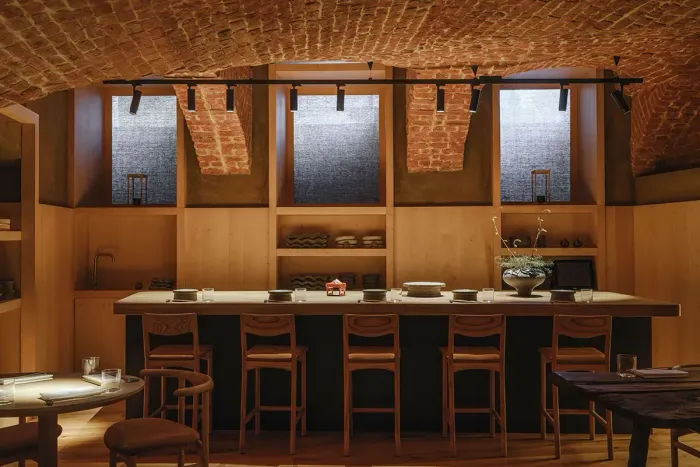
The space was designed by Natalia Belonogova's bureau: brick vaults, light wood furniture, the bar counter as the central element. Minimalism here isn't a stylistic device but a functional necessity — nothing should distract from the process. Jun is one of the few omakase restaurants in Moscow where the format is kept with no compromises.
Smolenskaya, 8
A White Rabbit Family restaurant occupying the top two floors of the "Azimut" hotel, with a panorama of Moscow that works as a course of its own. Chef Alexey Kogay runs the kitchen, with the group's overall brand chef Vladimir Mukhin setting the direction. The focus: Far Eastern seafood — oysters, crab, caviar, shrimp, sea urchin, surf clam.
The menu is split into several sections. The raw bar offers sashimi, crudo, ceviche, carpaccio. The Asian part: salmon-and-mango tartares, river eel, tuna belly in teriyaki sauce. The hot section: tataki, tempura, grilled items. Sakhalin operates as a full-fledged seafood restaurant with a Japanese accent, rather than a narrowly specialized sushi bar.
The interior was designed by Irina Glik's studio "Geometria": a restrained palette, dim lighting, panoramic glazing. The setting deliberately doesn't pull focus — the view takes that role. One of the best sushi bars in Moscow for those to whom height matters, both literally and culinarily.
A joint project by Anton Pinsky and Denis Romanov, built around the principle of live fire: there are no electric stoves, ovens, or deep fryers here. Every hot dish passes through a dedicated grill in the open kitchen. Fish for sushi and sashimi arrives from various points around the world — the logistics are built around freshness, not convenience.
Chef Maxim Samonov combines Japanese cutting mastery with open-fire techniques. The menu pairs raw items — nigiri, sashimi, rolls — with hot ones: fish and seafood over coals, grilled meat, smoky vegetables. That contrast of temperatures and textures is the whole intrigue of the meal. The cocktail list leans on Japanese distillates.
The interior is done in warm natural tones, dominated by stone and wood. The seats by the grill are the best in the house: watching the chefs work is part of what you're paying for. Amber is a sushi bar for those who want not just flavor, but a show too.
A White Rabbit Family project located a floor above "Gorynych" on Rozhdestvensky Boulevard. The concept joins the Japanese izakaya tradition with Peruvian culinary techniques — a pairing barely seen in Moscow before Ikura. Brand chef Vladimir Mukhin; in the kitchen, Dmitry Lim, known for his work across several WRF projects.
The menu is built around two poles: on one side, sushi, sashimi, tartares; on the other, Nikkei items — tiradito, ceviche, anticuchos. Fish and seafood are delivered daily, with the selection depending on the season. The robata section deserves special mention — hot dishes off the Japanese grill. The sake list is extensive, the cocktails signature.
The space is multi-level: a bar zone, the main room, private tables. The atmosphere leans closer to an evening club than a classic restaurant — the music's louder, the lighting dimmer, the pace faster. A Japanese restaurant in Moscow for those who want sushi and energy in one place.
The second wellbeing bistro from Boris Zarkov and Ksenia Sobchak within White Rabbit Family. The first location on Bolshaya Nikitskaya set the format — healthy food that doesn't feel restrictive. On Belaya Square, the concept was expanded: pizza was added, the space grew, and new rooms were introduced.
She's sushi section is one of the menu's strong points. Rolls, nigiri, and sashimi are made from fresh fish delivered daily. Alongside it, a hot kitchen runs with an emphasis on balance: bowls, protein salads, soups, steamed and grilled dishes. Desserts have no refined sugar. Drinks: matcha, kombucha, fresh juices, signature smoothies. The approach: tasty and healthy at once, with no compromise favoring either.
The design is bright and airy, with plenty of greenery and natural textures. She is built for a daytime format — breakfasts, business lunches, meetings over a light dinner. Sushi here is part of a broader wellness concept, not a story unto itself.
A joint project by Glen Ballis, Igor Kukarskikh, and Boris Panchenko in an izakaya format — a Japanese venue for informal relaxation over sake and snacks. Lucky recreates that spirit with Moscow adjustments: it's louder than a classic sushi bar, and freer in choosing between tradition and signature style.
Glen Ballis runs the kitchen. The menu is focused on snacks to go with drinks: yakitori, gyoza, tempura, tartares, sushi, and rolls. The fish is fresh, service is fast, and portions are meant for sharing. The sake list is one of the most serious in the city. Cocktails are built around Japanese ingredients: yuzu, shiso, umeshu. The format calls for several rounds of ordering, just like at a real Tokyo izakaya.
The interior is clean: wood, stone, dim lighting, the bar counter as the central axis. Live music in the evenings. Lucky is less a sushi bar than a place people come to spend an evening in a Japanese key, with good food and well-chosen sake.
A Lucky Group project led by chef Vasily Zaitsev, combining Chinese and Indonesian culinary traditions. The name references koji — the fermentation culture used for marinades on fish, meat, and vegetables. It's not just a technique but a philosophy: fermentation runs through every level of the menu.
The restaurant occupies two rooms: the main one, done in warm tones with wooden furniture and soft light, and a separate space with a bar counter. The menu splits into several sections: hand-made dim sum, wok noodles, wok and grill dishes, sushi and rolls with signature presentation. A separate section: Peking duck, served in several versions. The tea list is matched to the cuisine: oolongs, pu-erhs, jasmine varieties.
Koji is one of those restaurants where the Japanese element is organically woven into a broader Asian palette. Sushi here isn't the main dish but part of the shared table, and it's in that context of communal dinner that it comes through best. A pan-Asian Japanese restaurant in Moscow for a group, not for solitude.
A joint project by Anton Pinsky, Vitaly Istomin, and Artem Losev on Bolshaya Bronnaya. The cuisine is defined as unconventional Asian — classic Japanese formats reworked for modern tastes with elements of Peruvian and European technique. Sashimi, rolls, and nigiri sit alongside crudo, tartares, and hot robata items.
The menu is built around several directions: raw fish, grilled seafood, meat dishes with Asian marinades, green salads with signature dressings. The presentation is visually precise — every plate looks like an object. The cocktail list has an Asian accent: yuzu, matcha, shiso, tropical fruit.
The space was designed with an evening format in mind: dim lighting, deep seating, the bar as a social zone. Narnia occupies a niche between a strict sushi restaurant and a trendy Asian bar, and feels confident in it. For those seeking the best sushi in Moscow outside the classic Japanese canon.
The third restaurant by the Dreamteam group, founded by Dmitry Tyan. Format: Japanese cuisine given a signature reading — sushi, sashimi, hot dishes, and an extensive sake list. Tyan brought to Moscow recipes already tested at the group's St. Petersburg restaurants, and adapted them for a broader audience.
The culinary program combines traditional cutting with modern techniques: truffle tartares, tempura made from seasonal ingredients, hot rolls with unconventional fillings. The sake list is one of the deepest in the city: rare varieties, vertical tastings, pairings matched to dishes. Cocktails and wine serve as alternative directions for those not ready for sake.
The interior is minimalist, with an emphasis on natural materials and soft lighting. Self Edge Japanese is a restaurant for those who know Japanese cuisine well enough to appreciate the details: the quality of the cutting, the serving temperature, the balance of rice and fish.
A two-story Asian gastrobar by Ilya Tyutenkov. The concept is steeped in an Eastern philosophy, with Natalia Belonogova handling the visual side: the upper room in soft powder tones, the lower one dark, with neo-Baroque touches. Two floors, two different moods, united by a single kitchen.
The menu focuses on pan-Asian cuisine with a strong Japanese component: sushi and sashimi, rolls with signature toppings, tartares, hot wok- and grill-cooked seafood. The signature items are the robata dishes, where fish and vegetables pick up a distinctive smokiness. The cocktail list is built around Asian distillates and fermented ingredients.
Fullmoon operates as an evening project: DJ sets, dim lighting, a long bar counter. A sushi bar in Moscow for those to whom the atmosphere of a late dinner matters as much as the fish.
A White Rabbit Family gastro-theater on Romanov Lane. Three Japanese restaurants are brought together under one roof — Ayu, Uchiwa, and Tajiri Go — each with its own specialty. Brand chef Vladimir Mukhin. Format: omakase for a group of 8 to 12, where the chef decides the makeup of the dinner and guests watch the cooking.
Ayu specializes in sushi and sashimi from daily fish deliveries. Uchiwa focuses on hot dishes: tempura, yakitori, teppanyaki. Tajiri Go handles the meat side of Japanese cuisine: wagyu of various marbling grades, cooked over open fire. Dinner unfolds like a performance: a fixed start time, a unified pace of service, the chef commenting on every dish.
The interior was designed as a theatrical stage: open kitchens, bar counters arranged in a semicircle, minimal decor — all attention on the process. Wa Garden isn't a restaurant in the usual sense — it's an experience. One of the most unusual places for a Japanese-cuisine dinner in Moscow.
An intimate 30-seat Japanese restaurant by Arkady Novikov, a few minutes' walk from TSUM in the "Berlinsky Dom" shopping center. One of the city's oldest sushi projects: the name traces back to the surname of the first chef, who opened the kitchen and set a standard that's held to this day.
The menu is classic: sushi, sashimi, rolls, hot Japanese dishes. Fish is delivered daily, and the quality of the cutting is consistently high. Signature items: rolls with live crab, sushi made from choice tuna, tiradito. The hot section includes tempura, miso soups, wok dishes. Portions are neat, presentation precise.
The interior is compact, with a bar counter and a few tables. The atmosphere is focused, unhurried. Fumisawa is a sushi bar for those who value proven quality and aren't looking for culinary experiments. Consistency as the main selling point.
A Japanese restaurant by chef Park Lee, specializing in sushi and seafood. The project includes the main restaurant and a sushi bar at the Central Market. The menu reflects the latest culinary trends out of Tokyo — traditional techniques paired with modern presentation and unconventional combinations.
The strong point is the choice of fish: direct supply chains let the menu carry items rarely found in Moscow. Sushi and sashimi are served by the piece and as sets, hot dishes off the robata and teppan. A separate section: signature rolls with seasonal ingredients. The sake list is organized by region of Japan.
The interior is clean, with an emphasis on natural materials. The open sushi-prep zone lets you watch the chefs work. Tokyo Sushi is a sushi bar in Moscow for those to whom the authenticity of technique and the currency of the menu matter.
A restaurant by Alexey Repik, devoted to Japanese cuisine in its broad sense. The name comes from Tottori Prefecture, known for its sand dunes and fishing traditions. The emphasis is on three directions: ramen, wagyu, and gyoza — items that stay secondary at most Moscow sushi bars.
The ramen menu includes several base broths with variations: pork tonkotsu, chicken, a vegetarian miso base. Gyoza come with various fillings, from classic pork to shrimp with yuzu. Wagyu is served in several marbling grades, grilled or as tataki. Sushi and sashimi are present but don't dominate — Tottori is more about the hot side of Japan.
The space is divided into zones: a bar counter, the main room, a ramen section. The atmosphere is loud, lively, far from the minimalism of a typical sushi bar. The sake list is curated with rare bottles. Tottori is a Japanese restaurant in Moscow for those who want to go beyond the sushi set.
A sushi bistro by Glen Ballis and Alexey Oganezov, focused on healthy eating. The concept combines elements of Japanese and Korean gastronomy with techniques characteristic of the Spanish josper, an open-fire oven. The result: a menu where raw fish and charcoal-grilled vegetables coexist on equal footing.
The kitchen offers fish and vegetarian items: sushi from seasonal fish, poke, bowls, seaweed salads, hot dishes from the oven. There's no meat on the menu — the focus is on the sea and the garden. The presentation is minimalist, portions light. Drinks: natural wines, kombucha, tea, signature non-alcoholic cocktails.
The interior is bright, with elements of Scandinavian and Asian design: wood, ceramics, live plants. Cutfish is a sushi bar for those who choose a mindful approach to food and want their fish without any culinary compromise.
A restaurant of signature Japanese cuisine in a Moscow City tower, aimed at business dinners, corporate events, and meetings where a prestigious setting matters. An open kitchen, its own parking, a separate coat check — the infrastructure is built for the business-dining format.
The interior is done in a deep-sea minimalist style: dark tones, natural stone panels, brass accents. The menu includes sushi, sashimi, and rolls from daily fish deliveries, an oyster section, hot seafood dishes. The signature item: bluefin tuna sets, which gave the restaurant its name. The wine list emphasizes champagne and white wines.
Bluefin is built for a crowd for whom the restaurant is part of the business infrastructure. The sushi here is consistently high-level, and the atmosphere matches it. Not the most affordable spot in the roundup, but one of the most reliable for an important dinner.
A project by a team made up of Eduard Lunin, Evgeny Lakotkin, Alexey Beschastny, Denis Savinets, and Pavel Fadin. Located at a prime spot in the city with a view of Petrovsky Boulevard. The concept: Japanese cuisine with European details, without strict adherence to the canon.
On the basement level: a sushi bar with an open prep area. The main room is on the first floor, with panoramic glazing and a view of the boulevard. The menu includes sushi, sashimi, rolls, fish tartares, hot seafood, meat dishes with Japanese marinades. The cocktail list is built on Asian ingredients: yuzu, lychee, matcha.
Subzero operates as a dual-format restaurant: a calm sushi lunch by day, a bar atmosphere with cocktails and music by night. Works both for a business lunch and a Friday dinner with friends.
A project by chef Sang Keun Oh, who worked before Moscow in the kitchen of London's L'Etranger and on private yachts. Oh not only puts together the menu but also creates signature tableware for presentation — every plate is designed for a specific dish. That level of attention to detail defines the whole restaurant.
The kitchen is built around classic Japanese technique with occasional touches of European method. Sushi and sashimi come from premium-class fish, hot dishes off the robata and teppan. Signature items: tuna tartare with truffle oil, soft-shell crab tempura, a wagyu roll. The sake list is compact but well-chosen.
The interior is restrained, with wood paneling and soft overhead lighting. Hibiki is a sushi bar in Moscow for guests who understand the difference between fresh fish and excellent fish. It closes out the roundup — and closes it on a high note.
05.04.2025
The best places in the city