The Best Places for Dinner in Saint Petersburg
25 Saint Petersburg restaurants for your evening: gastro-bistros, pasta, meat off the fire, wine, and places you'll want to come back to at night.08.08.26
In our favourite city, our guide's editors have flagged around 50 strong places — but here are the 25 best for dinner or a date.
The best places for dinner in St. Petersburg rarely come down to one format. Here an evening might start with Japanese omakase behind an unmarked door, continue by an open flame, or gather around pasta, wine, and a big table. There are restaurants for a date with a view of the water, gastro-bistros for a calm dinner after work, Georgian and Greek addresses for a long feast, meat-focused projects with dry-aging chambers, and places where a strong chef stands behind the kitchen. We took 25 restaurants from our guide with high ratings for dinner and gathered them into one list — for the times when you don't just want to eat in the evening but to choose a place to match your mood, conversation, and company.
Petrogradskaya Embankment, 18
Dmitry Blinov took borscht and cutlets from childhood and rebuilt them so the dish stops being merely recognisable — for a dinner for two that works more precisely than any chef's-table cuisine. Cold-smoked mackerel with sour cream kvass, Lake Ladoga zander with pike roe, beef tongue with horseradish ice cream — the flavours surprise without losing their warmth. Vaulted ceilings and an open kitchen keep the room both festive and light: it suits a first date and an important anniversary alike. The coat-check tags are Soviet bus tickets, and you'll want to catch a "lucky" one. The list runs to almost three hundred wines, including Russian producers.
Dobrolyubova, 11
A meat display right in the dining room and dry-aging chambers built into the interior alongside live flowers — this is where you come when dinner needs to be remembered for the quality of the meat, not the decor. Andrei Kovalev, known from Tartarbar, works with open fire and aging: yakitori from marbled beef, black cod with miso, bone-in steaks the chef carves tableside. The Florentine tartare and picanha with citrus ponzu suit you if you want less pretension and more flavour. For dessert — an eggplant tarte tatin with miso caramel by Stas Paul, named the country's best pastry chef by Where To Eat in 2025.
A door with no sign and a flower arrangement at the entrance — dinner here starts with the search for the place itself. Aleksey Penyuk's interior is built from walnut furniture, marble, and vintage cabinets, while a Latin groove takes the edge off Japanese restraint. Brand chef Aleksey Kanevsky works with wild fish from the Atlantic and the Sea of Japan: sashimi is served from the chef's table by the open kitchen, and yellowtail nigiri comes with fresh-grated wasabi. Magadan botan shrimp is caught off the Russian coast and sold to Japan, only to return to the table from there. Here dinner calls for sake rather than wine — and it works.
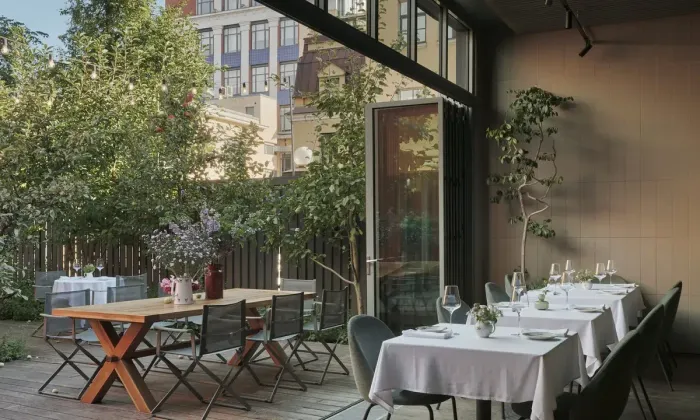
Harvest is the rare case where dinner can be built around vegetables and you won't feel like anything is missing. Dmitry Blinov and Renat Malikov split the menu into "Vegetables only" and "Not only vegetables" — yes, there's fish and meat too, but the star of the menu is beetroot, cured in powdered sugar and served with young cheese. Instead of wine, dinner comes with fresh-pressed vegetable, fruit, and berry juices — an unexpected but precise choice for a light evening. Aleksey Penyuk's interior holds light tones, natural materials, and a spiral staircase without excess decoration. It works especially well on the terrace in the warm season.
By day it's a coffee shop under a glass dome, but by evening the glazed courtyard of an 1859 mansion changes tone — the light softens, and a light fine-dining air settles over the room. Brand chef Viktor Kislinsky keeps beef tartare with sauce Mornay and toasted house bread on the menu, along with beef tongue with pepper sauce and onion jam, and a niçoise with tuna confit. Anastasia Maksimova's wine list runs to around 250 labels with an emphasis on France and Italy, while the cocktail programme by head bartender Aleksandr Nekrasov travels through France in three chapters: "Beach," "Garden," "Mountains."
The round market on the Moika isn't where you'd expect to find an authentic Greek taverna, but that's exactly where Aleksey Burov opened one. For dinner for two, there's the canonical tzatziki, Halkidiki olives, and PDO feta — a flavour like your grandmother's, somewhere on Crete. Dorado and loukoumades doughnuts for dessert close the evening without unnecessary ceremony. The wine list is drawn from mainland Greece, Santorini, and Italy, and the bar offers Mediterranean twists on the classics. Wooden signs, antique cabinets, and white tablecloths keep the kind of ease that makes dinner relaxed rather than formal.
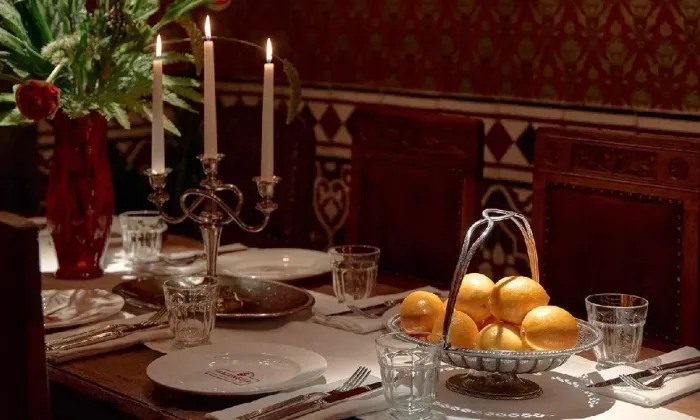
The evening here is built around the bar counter and a glass of wine — out of fifteen labels, you can confidently ask the waiter for the "wine of the day," which isn't even written on the list. Chef Ivan Frolukhin, nicknamed "the Frenchman," unexpectedly sets brie with truffle next to a crudo of fennel and asparagus on a cream of goat cheese. Everything is served on Gien faience — a rarity for St. Petersburg tables. Vienna chairs, lampshades, and mirrors with patina create the kind of setting where you want to stay longer, especially for a dinner for two when the conversation is in no hurry to end.
Murad Berdiev's project works without unnecessary gestures: oysters, fish and chips, and squid guacamole to start, halibut in champagne sauce or grilled sea bass for the main event of the evening. Murad puts the menu together himself, and it shows in the choice of product. The interior by the DA bureau team plays with light, sun-bleached tones — the tabletops recall a calm sea surface, and the light fixtures are shaped like coral. A glass of white or sparkling wine fits easily with this kind of dinner: the fish, the light, and the calm room all work without unnecessary ceremony.
Fire isn't a detail of the interior here but the centre of the whole idea: an Italian wood oven and a Spanish charcoal one run in parallel, and the flavour of the dishes is built around smoke and heat rather than around any one cuisine. The room, designed by Aleksey Penyuk and Anastasia Artemyeva, reads as a gallery space with a view of the Tavrichesky Garden — plenty of light, deliberately little decor. The wine list is curated by Angelina Gayvoronskaya, and the sake-based cocktails are the work of Elena Latypova. For a private dinner there's a separate room with Scarpa and Bellini furniture — a rare format for those who want an evening away from other people's eyes.
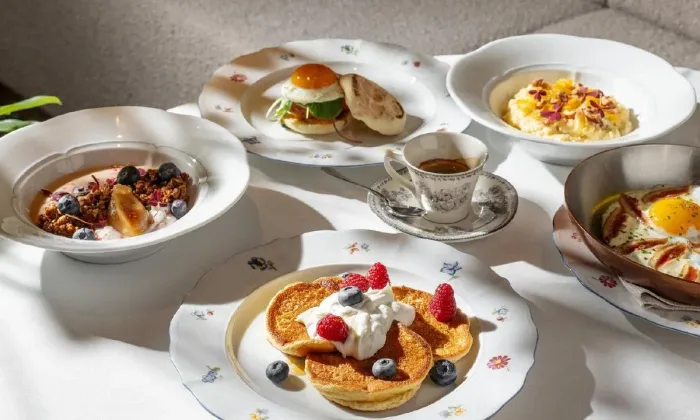
The restaurant's real protagonist is an actual apple orchard that blooms right on the summer terrace in spring. Founders Natalya Tsyplenko, Anna Ovchinnikova, and Sergey Simak bet not on effect but on natural rhythm: chef Anna Ryaznanskaya builds the menu on clean, childhood-familiar flavours without unnecessary layering. Inside there's a fireplace with a live flame, white tablecloths, and porcelain with a floral pattern, while Adelaida Iskhakova handles the wine with a selection from premium regions. Good for an evening when you want quiet and the feel of a country house in the middle of the city.
The name is simply short for Bistecca alla Fiorentina, the Tuscan steak grilled over coals, and the entire kitchen is built around that idea: grilled meat, handmade pasta with unexpected combinations, no bland classics for the sake of being classic. Two rooms contrast with each other — one with original frescoes, the other with Tiffany-technique stained glass, and the walls hang with work by young St. Petersburg artists. On Fridays it gets loud and festive, almost like a European osteria. For dinner, we recommend the halibut with beurre blanc sauce and the tiramisu, assembled right at the table.
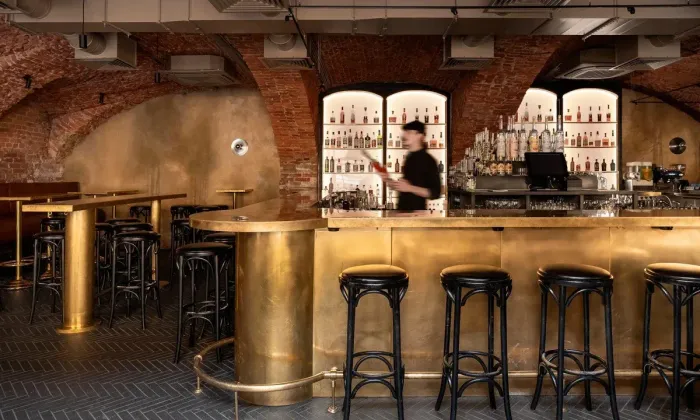
The name translates as "living room," and that's literally how it feels at the table: a brass bar counter, ironic Renaissance-style frescoes, Ginori tableware, and Mark Thomas glassware — you want to stay a while. The pasta splits into two camps: handmade, rolled to an Emilia-Romagna recipe, and the factory-made Gentile, brought in from Gragnano near Naples. Vadim Ovchinnikov builds the cocktails around Italian film references, and the wine list joins recognised classics with small artisan wineries. A format for an evening where conversation matters, at a big shared table that spills from room to room.
A quarter of a century in the same spot is rare on the restaurant market, and Probka holds it without a single concession: vitello tonnato, thin slices of veal under a sauce of tuna and anchovies, hasn't left the menu since day one. Tajarin with Piedmontese sausage is mixed at forty egg yolks per kilo of flour, and tortelli with burrata and truffle has been a favourite for two decades already. The room has an open kitchen from the Florentine Gullo works and white plates signed by guests like Mick Jagger and Meryl Streep. A fun-dining format without pretension — people come here for a reliable flavour and the wine list, honoured every year by Wine Spectator.
Aram Mnatsakanov's first Georgian project begins with a compliment — a hot shotis puri flatbread pulled straight from the clay tone oven. Gia Khuchua put the menu together with care, without modernist experiments: Adjarian khachapuri with two kinds of cheese, ravioli with kuchmachi and chanterelles, juicy khinkali. The wine list gives noticeable room to orange wines — an unusual detail for a Georgian restaurant. The space recalls a Tbilisi courtyard: half-light, spot lighting, greenery, and worn wood. Good for a long feast-style evening when you want warmth and generosity on the table.
The name translates as "birch," though the menu unexpectedly leans toward author's Asian cuisine with an emphasis on umami — the combinations here are unfamiliar and slightly disorienting in a good way. The main reason to come in the evening is two set menus by Arslan Berdiev in a chef's-table format, where the chef works right in front of the guests. The interior by the DA bureau really is inspired by a birch grove: light wood, stainless steel, and a monochrome restraint without excess decor. A format for those looking for a gastronomic dinner without long explanations — you just sit down and trust the chef.
The restaurant on Bolshaya Morskaya rests on the personality of one man — brand chef Manuel Suraci, from a Calabrian dynasty of pizzaioli (his grandfather is a Guinness record holder for age in the profession). Hence the name: Da Manu, "at Manu's place." Twelve kinds of pizza on a thin crust, similar to a Sardinian flatbread, sit alongside vitello tonnato and strozzapreti with wild boar ragù. The room seats only 26 — marble tables, a reproduction of Luca Giordano above the sofa, panels of Karelian birch. For a quiet dinner for two under a crystal chandelier, or a summer evening on the terrace, it's one of the precise addresses in the centre.
A gastro-bar from the Duo Band team — Dmitry Blinov and Renat Malikov — built around raw cuisine: tartares, tataki, carpaccio, and ceviche with dense, almost bold sauces take up most of the menu. Among the hot dishes: beef tongue with purée and sun-dried tomatoes; for dessert, ice cream made from baked apples. Aleksey Penyuk's interior (studio APPA) plays on contrast: rough concrete and brick, a crystal chandelier over the bar counter, live plants breaking through cracks in the walls. For a dinner where conversation and attention to detail on the plate matter more than the number of dishes, the format fits perfectly.
Banshchiki occupies the former Degtyarny Baths building and turns the bathhouse history into a restaurant with the tone of a country house. Several rooms are set up for different occasions: a space on the ground floor for an ordinary dinner, a formal room on the second floor for something more serious, and an intimate cabinet with a big family table for a private group. The kitchen builds on Russian classics reworked with contemporary techniques, joined by the "Moments" cocktail list. Warm tones, natural wood, and a thought-through layout remove any sense of rush — you'll want to stay late.
Aram Mnatsakanov's second St. Petersburg project after Da Manu — an Italian-Lebanese restaurant and a sequel to Moscow's Mina. Sergey Bich runs the kitchen, drawing on the experience of brand chefs Gilberto Nasser and Manuel Suraci. Every guest is greeted with a compliment — hot flatbreads — and then comes a procession of meze, meant to be shared slowly between two. The space is bright and green, with a nod to bourgeois Beirut of the last century's middle decades — a showcase of Middle Eastern hospitality without pretension. A good choice when you want a dinner with an unfamiliar flavour but no exotic risk.
A restaurant on the deck of the "Flying Dutchman" by Mytninskaya Embankment — a project by Anton Pinsky and Ksenia Sobchak built around the view. The windows open onto a panorama of the Neva: in summer ships pass by, in winter the picture barely loses to the summer one. Chef Mikhail Bobylev built the menu around recognisable but precise dishes — a crab salad, seafood dumplings, a confit duck leg with sweet-potato purée and Porto sauce. The interior has a Moscow-scale sweep: warm tones, textured furniture, white tablecloths on the tables. For a date with a view of the water, it's a rare case where the location works as hard as the kitchen.
In New Holland, Kuznya House gathers approachable European cuisine: chef Ruslan Zakirov keeps a chicken pâté with apricot purée, a beef tartare, lamb with new potatoes, and a lasagna with four cheeses and truffle on the menu. Salmon, pastrami, and ham are smoked in the house's own smokehouse, and bread and croissants are baked daily. In summer the terraces open with a view of the island; in winter you can stop by for mulled wine after skating. After 11pm on weekends, dinner smoothly turns into a club format with DJ Kirill Sergeev — an option for those planning an evening longer than one course.
Giallo is named after the Italian film genre — a blend of thriller, detective story, and eroticism — and it shows in the interior: lacquered mahogany panels, vintage furniture, a curved bar counter, and Murano glass chandeliers carry you into a sixties mood. A project by the EZO Izakaya and italy&co teams together with restaurateur Aleksandr Sysoev, it works with Italian cuisine outside the classic frame, and one of the rooms holds a vinyl record collection — music here is as much a part of the menu as the food. The cocktail list keeps the evening's pace. A place more for a group of friends or a date at the bar than a quiet dinner for two.
The entrance to Tiger Lily runs through a flower shop in the "Passazh" arcade on Nevsky — there's no sign, and that's part of the game from the Co-op Garage and Jack & Chan team. The menu rests on a Chinese base with pan-Asian additions — bang bang shrimp, smashed cucumbers with cashews, kung pao chicken. Andrei Perepechko's interior plays on contrast with the location: stained-glass windows, dark wood with metal, unusually shaped chandeliers, while hip-hop plays from the speakers, noticeably at odds with the room's visual restraint. For a dinner without formality, when the atmosphere of a hidden club matters more than a classic set of dishes.
Atelier tapas&bar fires its hosper with grapevine — a Spanish charcoal oven that holds its temperature for hours without leaving a resinous taste. Chef Vladimir Vorgulev builds the menu like a Spanish feast: 36-month Iberico jamón, Basque pintxos on brioche, beef tartare with manchego, a machete steak with smoked sweet potato. Kseniya Smirnova's interior is deliberately eclectic — a copper chandelier, a wooden table instead of a bar counter right in the room, a neon sign reading "No Bad Days." In summer the terrace turns into a slice of Barcelona. A format that suits an aperitif for two and a long dinner with wine until closing.
Grecco on Rybatskaya Street gathers Mediterranean cuisine from four regions — Greece, Italy, the Côte d'Azur, and the Basque Country — without sharp borders between them. The interior deliberately returns to the atmosphere of a 1950s–60s resort hotel: a light carpet, panels of polished wood in a warm walnut tone, minimalism without coldness. The relaxed, lobby-like room takes the tension out of a business dinner — you can even bring a dog, a rarity for a restaurant at this level. A good choice for an unhurried evening when the mood of a holiday matters more than a strict script of dishes.
08.08.2026
The best places in the city